Showing posts with label adult gaming. Show all posts

Monday, September 15, 2014

The Bittersweet Backlog


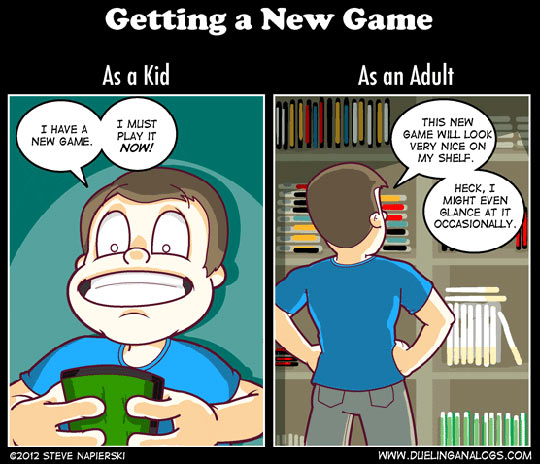
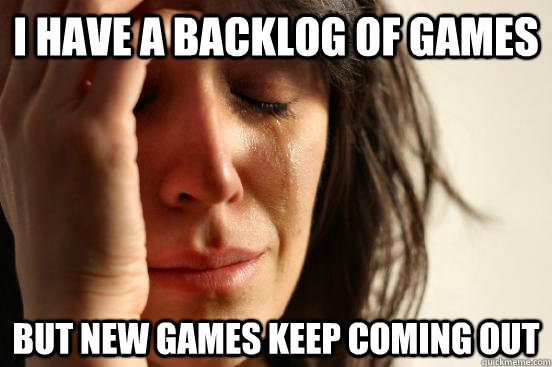
I have a lot of video games.  Well, that's an understatement.  Honestly I probably own more video games than I could even finish before I die.  And yet knowing this, I still collect new games on a weekly basis.  More and more virtual voyages added to the unceasing pile.  With decades behind me of collecting, one could write it off as simply an old habit.  It might be that, but in a positive light one could say this is continuous library building for posterity.  Whether or not it's a good thing, the fact remains I own multitudes of video games I have not played yet.  They sit neatly organized and alphabetically congealed into segregated areas based on their respective platform.  Waiting patiently for their time to shine.  The truth is some of them will never get that chance.

It's not that I don't play, oh I play video games as much as I can.  "Can" being the operative word there based on playing in my free time.  My "free time" being that which I am not spending on my day job, adult responsibilities/chores, family obligations, relationship quality time, additional hobbies and other such necessities.  A mature responsible social adult cannot play video games with the same frequency they did as a carefree teen.  These days I average twelve to fourteen hours a week because of this reality.  I still have to sacrifice plenty of sleep just to pull off that amount.


Due to this situation I am a time traveling gamer.  As in, I play games from all eras of gaming.  This is born from having a backlog spanning decades.  There are still games I haven't played from the 8-bit era that I fully intend to play some day.  Despite their technological obsolescence.  All the same, I also play brand new modern releases.  But what I do not do, is disallow entire eras of gaming just because the next era has begun.  There are some people who do this.  "The PS4 came out?  The PS3 is now dead to me.  And don't even talk about the PS2 or PS1, that's just stone age crap."  To me this sort of thought process is needlessly dismissive, and illogical.  But from a purely technophile point of view, I guess I can understand their side of the argument.  I just don't share it.

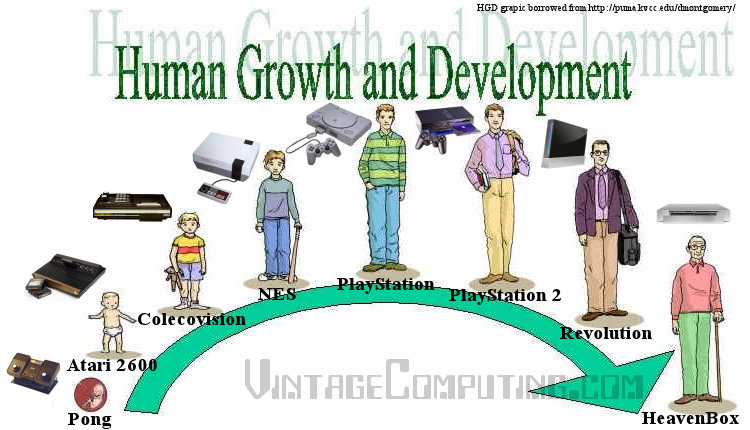
An example of this?  Lately I've been playing King's Field (Japan), a game released in 1994.  It is 20 years old currently, but I've only just now gotten around to playing it.  One might wonder why I'd bother playing From Software's first release, when I've got a PS3 and their recent Dark Souls sitting in the same room (which I have not played yet).  I guess part of my reason would be due to scholarly inquisitiveness.  Historically speaking King's Field (Japan) is a significant release.  So to play an old game is to go back in time to a degree.  A larger degree though, is I'm able to disregard the graphical merit of a game, and rather enjoy its core gameplay as a separate entity.  This may have to do with growing up from Atari 2600 graphics.  I came from a time when gameplay sold a game as much (or more than) graphics did.   Having the ability to see beyond graphics is a double edged sword of course.  It means I can't disregard huge swaths of my backlog simply because of their archaic pixels.


Currently my backlog spans from the 1980's to 2014.  That's over thirty years of collecting.  So how does one begin to dig through a backlog that spans so many years?  Trying to prioritize what to play, and realizing one doesn't have time to play it all, can lead to backlog anxiety.  Feelings of shame, remorse, and loathing might manifest as a result.  I've been there!  I understand why folks come up with complex methods of dealing with this.  Some sort of regimen, or algorithm, designed to prioritize the top "must plays" or "most expensive rarities" of their respective backlog.  I am guilty of concocting such stratagem shenanigans myself in the past.   Let me tell you, that's a young man's game.  Age has brought me the realization that backlog anxiety is just silly and ultimately toxic.  The answer? Acceptance is the key.  It's not the same thing as apathy either.

Do I have too many video games?  Yes, and I accept that.  Do I need to stop buying them until I finish what I already have?  That would be financially logical, but psychologically unsatisfying, so no, I won't do that.  My fiance and I created a gaming budget for that instead.  Will I ever finish every video game I have?  Hell no.  I will be dead before that can even happen.  I accept that.  Is there a truly efficient way to choose what to play from one's backlog?  Maybe.  Do I really care?  Not anymore.  I accept that.  Instead I play what my ardent gamer heart yearns for, regardless of genre, release date, or game time length.  Hence I'm playing a Japanese oddity from 1994 right now.  Yes I could handle my backlog in a more efficient and hierarchical manner, I know this.  But I choose not to.  I accept that.

In reality my backlog is a monster.  It's a monster that I cannot slay, and yet I feed it more every week.  Maybe because I am in awe of its size and like to see it grow.  Or maybe my backlog is a well, keeping me hydrated in my unquenchable thirst for new gaming experiences.  And therein lies the two sides of the backlog coin.  Bitter monster, sweet well.  This is true, and I accept it.  But I no longer accept my backlog as a source of anxiety.  The librarian does not rue the library, nor the curator fear the exhibits.  Rather they revel in their potential.  And that is the beauty of a big backlog; pure potential.  That's why a pile of up-to-date-modern-only games can't match my backlog.  My crazy time spanning backlog is a monstrous well of potential.  And from it I can always sip a little joy as life permits.  So I throw a few coins in it every week, making the wish that it never runs dry.

Wednesday, September 10, 2014

Co-op Couples


Every relationship needs entertainment to combat the boredom lulls.  Couples can only frolic in romance and coitus for so long.  Often this ends in copious amounts of watching television or window shopping.  Initially in my own relationship, my significant other was interested in hiking and playing with our new dog.  Fine endeavors indeed, but I wanted to slay dragons and shoot aliens too.  So one night as she sat next to me in front of the HDTV, I asked if she wanted to play a video game with me.  Her reply was, "I don't play video games, but I'll watch you play them."

This was not an acceptable answer.  I was determined to find a video game my lover would enjoy.  And so I began showing her quite the variety.  Kirby's Epic Yarn made her want to vomit.  Bucky O'Hare arcade version?  Not a fan.  Donkey Kong Country Returns wasn't much fun.  After about a dozen random tries like this, I was nearly ready to give up.  I just couldn't find the gateway game.  So for our last go, I took a wild shot in the dark.  That night's final game was ObsCure: The Aftermath; a very difficult, gory, and brutal co-op survival horror game.  I figured she'd hate it.  I was wrong.  She loved it.  I had found her gateway game.


After we spent a few evenings finishing ObsCure: The Aftermath, she was ready for more.  So over the next few weeks, we took on Resident Evil: The Umbrella Chronicles, Baldur's Gate: Dark Alliance, and Trauma Center: New Blood. We completed them all cooperatively, and she enjoyed every minute.  Turns out I had simply underestimated her tastes.  She didn't hate video games, she just hated cutesy fluffy ones.  She couldn't get enough of the dark and serious stuff though.  By sheer determination and experimentation, I had found a golden compromise.  I was getting more gaming time, and she was getting new experiences in entertainment.  And something even greater was happening beneath the surface. Our relationship was becoming stronger due to the power of cooperative gaming.

This beneficial aspect wasn't something I had consciously realized immediately.  But over time, I had noticed that when we were faced with a mutual real life conundrum, our problem solving skills seemed to occur more smoothly then before.  I couldn't help but wonder if all those virtual hours spent cooperatively solving puzzles and killing monsters had accomplished more than just entertainment.  It seemed that our simultaneous electronic victories somehow translated into real world relational stat bonuses.  If nothing else, instinctively we learned to know when to back off from an issue and let the other handle it.  I have no doubt that cooperative gaming has helped develop that particular sixth sense more strongly for us.


I am not saying that two people in a relationship playing video games together need nothing else to help strengthen their bonds.  Obviously if a marriage is going sour, beating Bubble Bobble together won't replace a counselor's help. I'm only saying that working together to beat a game, mutually overcoming its obstacles together via teamwork, that sort of entertainment has tangible merit.  I refuse to believe sitting around watching reality television has the same sort of teamwork building skills as co-op gaming does.  And I encourage gamers to get their non-gaming partners into playing games with them because of that.  Taking down a huge beast cooperatively in Monster Hunter has got to do more for your relationship than window shopping for new winter coats.

You might be surprised at how many things there are to cooperate on in a video game.  For example, in Baldur's Gate: Dark Alliance, there was an entire economy to mutually endure.  Firstly you had the finite resource of gold pieces to distribute evenly.  Secondly you had random loot drops to dole out fairly.  That dropped flame sword might never appear again, so only one of you gets to have it.  Who?  Which items are worth buying from the shopkeeper, and who gets to keep them?  If the path ahead diverges, which hallway do you two take?  Who makes that decision?  What's the proper strategy to use to kill that boss?  And who gets the killing blow?  There were so many factors to puzzle over, only to be solved together for the greater victory of cooperation.  Surely after doing all of this, divvying up the mundane bills and chores of real life becomes more intuitive.

It stands to reason then, that this same sort of relationship building cooperative gaming magic applies beyond the amorous sphere as well.  I could certainly believe beating games together with a close friend would have tangible offsets.  If nothing else, you'd learn a little more about each others' personal strengths and weaknesses.  (Seriously, if you want to know someone's true personality, play Dokapon Kingdom with them.)  So if your partner doesn't play video games, but you'd like them too, just keep trying.  There's a genre out there for everybody, and chances are it has some co-op titles available within.  Whether you choose to play couch co-op games with your significant other, your friends, or even your children, there are positive results for all involved.


Co-op gaming sites for finding stuff to play:

http://www.co-optimus.com/

http://www.gweep.net/~rocko/coop/

http://en.wikipedia.org/wiki/List_of_cooperative_video_games

http://www.mobygames.com/attribute/sheet/attributeId,619/

Tuesday, September 2, 2014

Grown Ups VS Gaming - Part 4 of 4: Evident Evolution

This post is part four of a series beginning with this post.

The above infographic is one I selected at random.  I didn't need to cherry pick because there are many more like it, from various studies and sources.  They all say the same thing.  As people get older, they are continuing to play video games.  The amount of adults who choose to play video games beyond their youth is clearly on the rise.  Adults who believe video games are inherently childish and a waste of time, are in fact a dying breed of dinosaur thinkers.  I'm looking forward to their extinction.  Perhaps the best piece of news lately though, is the amount of women playing video games.

There has been an explosion in recent years concerning the amount of grown females who consider gaming a hobby.  Here are some links to ponder: 1 | 2 | 3 No matter how you slice it, adult women are into gaming now more than ever.  The reason this excites me, is it can lead to more diversification of gaming genres, and gameplay design.  Indeed, many of my favorite video game designers have been female.  Such as Rika Suzuki, Roberta Williams, and Rieko Kodama, to name just a few.  Also I can tell you with full authority that playing co-op campaign games with your significant other is wonderful.  So this is great news for video game loving men seeking video game loving women.  Or video game loving women seeking video game loving women even.  Anyway it's great to see the genders of this medium's demographic evolving beyond the "teenage boy" stereotype.
 
Another positive trend in gaming is the amount of money the industry is making.  There's already been years where the video game industry has surpassed other entertainment mediums.  And is forecast to continue doing so.  This industry is so lucrative, states have begun adding special tax incentives to lure developers.  It stands to reason that not only are more adults playing games, more adults are making their living making them.  I believe in time this will lead to further maturation of the subject matter of game design.  I wouldn't mind the lead protagonist in my next action adventure title being a middle aged man going through a midlife crisis.

Another interesting trend is the amount of senior citizens playing video games.  Maybe this started with the Wii sports phenomenon?  Science says video gaming is good for our elders though, and senior citizen retirement homes are aware of this.  And so is Nintendo.  Well I for one have amassed a backlog that I plan to play well into retirement, that's for sure.

Truly video gaming has never been more robust and widespread than it is today.  Yet I still think we are far from populace saturation insofar as who can play, or what could be played.  Regardless, the point of this series was to show how gaming started out as something that could be seen as childish, but has matured over time into a medium that any respectable adult should enjoy with impunity.  The stereotypes of this hobby are slowly eroding to reveal as diverse a demographic as any other form of entertainment. 

Video games are not for anyone, they are for everyone.  If as a video game playing adult you are ever told you are ever wasting your life enjoying this hobby, remember this Ardent series and don't feel ashamed.  Rather, feel empathetic embarrassment for the ignorance of the person who just said this to you.  Why not invite them to try a game or two?  They might just change their archaic opinion.  Yes fellow gamers, we can erase the last remnants of this stigma, one convert at a time.

Friday, August 29, 2014

Grown Ups VS Gaming - Part 3 of 4: Mature Misconceptions

This post is part three of a series beginning with this post.

"You're an adult and you still play video games? Get a life!"

"Get a life."  That short dismissive phrase is a common one spewed time and again towards adult gamers.  Said phrase is typically muttered towards older gamers by relatives, co-workers, even potential dating partners, when they discover the grown up who still plays video games.  It seems not uncommon for an adult who does not play video games to assume that another adult who does is doing so out of "not having a life".  It's like assuming that all a gamer ever does is play video games, which is entirely not possible, or said gamer would be dead.  In reality the "life" the non-gamer speaks of is the way in which the gamer is spending their free time in regards to entertainment.  But what is the "life" of a typical non-gamer then?  Just what does the average American adult spend their free time on?

The Big Bang Theory and Facebook.  I'm not kidding.  Here are some sources:

1 | 2 | 3 | 4 | 5 | 6 | 7

Based on the evidence, the average American adult spends about 3 hours of free time each evening watching non-educational television whilst simultaneously browsing Facebook on their smartphone.  That is supposedly the accepted way for an adult to spend their free time.  It's ironic then that some adults would consider myself a 35 year old man as being a childish nerd by playing Ys Origin last night, instead of catching up on the shenanigans of fictional childish nerds on TV instead.

If you talk to adults who don't like video games, they often make consistent arguments as to why they think gaming is useless and childish.  Terms such as "brain rotting", "waste of time", "antisocial", "immature", and "useless" are thrown around often.  Some of those aspects certainly could apply in particular situations, but holistically speaking, they are not inclusively true of the entire medium.  Never mind that any of those terms could arguably be used against the average television show or Facebook post.  All the same, I'll explain my view as to why video games are not necessarily any of those negative things in general.


Are video games brain rotting?  An interactive medium that requires user feedback in order to be enjoyed... cerebrally detrimental?  Even in the simplest of video games, the brain is not going underutilized.  Rather the mind most constantly perceive problems and offer solutions to overcome then.  From something as simple as timing a Mario jump onto a Koopa, to concocting stratagems to defeat a massively challenging boss in a JRPG such as Etrian Odyssey.  After all, video games do not beat themselves, the brain does.  And the brain grows in power as such.  But don't take my word for, read up on the science: 1 | 2 | 3 The truth is, video gaming is actually useful exercise for your grey matter.  Especially if you're into the adventures of this capital chap.

Are video games a waste of time?  I hear this so often about the medium that I plan to do a detailed post about it soon, as the true answers are long.  But I'll keep it simple for now.  If you take time out during your day to devote to entertainment, than any form of entertainment has the potential for being "a waste of time".  Decrying any singular entertainment medium as more a waste of time than another is solely subjective, with no objective logical rational to back the claim.  Truly if you're watching fictional non-educational television for example, in no way is that less a waste of time than playing a fictional non-educational video game.  If you're reading a fantasy book, that's no less a "waste of time" than reading hundreds of pages of text in your average video game RPG.  Let's not forget that ultimately the very point of unwinding via entertainment is to "waste time" and relax in the first place.

Are video games antisocial?  It all depends.  Is someone playing a 3DS on a bus being more antisocial than someone else on that bus who's browsing on an iPhone?  Of course not.  Is a person playing a single player video game alone being any more antisocial than someone reading a book alone?  Have you ever heard of a reader being called antisocial?  And at least another person can watch someone play a single player video game, who wants to watch someone read a book?  I bet you've heard of the Wii.  Want to know why the Wii sold so well?  Because it made local multiplayer gaming easier than ever before.  Hence it had the best selling game of all time, hardly an antisocial experience.  From an online perspective, video games have never been more social with MMO franchises, hence the untold millions Blizzard has made from World Of Warcraft.  And let's not ignore the rising fervor for eSports, an entirely social collective.  The fact is video gaming offers the ability to be the most social medium, due to cooperative gameplay, and competitive gameplay.  And yes it can also be a nice bastion from the ruckus of reality.  But someone choosing to play a video game alone in their bedroom is being no more antisocial than someone listening to an album alone in their bedroom.  The medium of any given type entertainment is irrelevant, rather it's the physical isolation itself that's "antisocial" in nature.  Someone must choose to be antisocial on their own, their hobby doesn't define that for them.

Are video games immature?  That would assume all video games are made for kids.  That's not the case, hence the existence of ESRB ratings. Just as there are films made for kids or adults, there are games made as such.  In that regard video games are not inherently "immature" anymore than films, it's a fallacy to claim as such.  Perhaps a non-gaming grownup would consider the activity of mass slaughter in a title such as God Of War or Grand Theft Auto to be immature in nature.  But to label all of video gaming "immature" by citing games such as those, that is to ignore distinctly polar opposite games in the same medium.  I'm talking about higher brow stuff like Cosmology Of Kyoto or the wonderful works of Kheops Studio, let alone the astonishing output of CiNG. Or is it the very act of interacting with a video game itself that's the immature aspect?  That would mean that if I played chess in real life I was not being immature, yet if I played a chess video game instead I was being immature. Completely illogical.

Are video games useless?  Absolutely not.  I linked earlier to brain studies showing how video games can increase grey matter and improve dexterity.  They are used to train soldiersteach codingtrain pilots, even surgeons.  Sometimes games have unexpected uses, they even help keep thugs off the street, or out of your house.  The benefits of gaming go on, and on, and on.  And I haven't even mentioned how much money the video game industry is worth, and that's billions.  How can you call something that employs thousands of people across the world and feeds their families "useless"?  Not to mention the countless hours of entertainment the industry provides to the entire world on a daily basis.  Video games are about as useless as oxygen.


I hope in writing all this I've helped to shed some light on the hypocrisy of non-gaming adults' misconceptions about the medium.  Or at least provided some ammo the next time you may need to defend your favorite hobby.  The next time someone tells you to "get a life" about playing video games, you can tell them to "get educated" about them instead.  The good news is the entire civilized world's perspective of this medium is shifting over time.  There will come a day when those who think video games are children's play things will be the biased outliers, not in any way the norm.  And that day is coming sooner than they think.  In the next post in this series, I will elaborate upon this illustrious world to come.

This series is continued in this post.

Friday, August 22, 2014

Grown Ups VS Gaming - Part 2 of 4: Troubling Terminology

This post is part two of a series beginning with this post.

What if books were called paper scribbles?  And instead of reading books, you looked at them.  Thus instead of "reading a book", you called the activity looking at paper scribbles.  That's a rather demeaning way to describe the act of mentally digesting literature, no?  And what if films were called flashy pictures?  Does watching flashy pictures sound less distinguished than viewing a film? And what if music albums were called noise gimmicks?  In that case we never played a record, rather we spun noise gimmicks.  Now there's something a proper grown up would not do 'eh?  But luckily in all of those mediums, there exists classier terminology widely accepted culturally.  Too bad video games got a bad rap then.


Think about the name "video game" objectively.  Is that not a rather rote term for something as amazing as what it actually is?  The marriage of technology, multiple art forms, artificial reality, and actual interactivity... a brilliant cluster of potential.  Yet we commonly call this phenomenon simply a "video game".  Apparently a description that an unknown reporter coined for the magazine Vending Times during a Chicago tradeshow in 1971 (source).  Granted calling an unusual bit of technology a name based on its pure fundamentals was understandable... at that time. Unfortunately 43 years later this saddled name does not adequately encompass the scope of the medium today.  And yet we are still stuck with it culturally.  The medium therefore suffers the consequence of ignorance based on its illicit implication.  It's not the "video" part of course.  That just implies a picture in motion, fair enough.  It's the "game" part.


"Games are for children."  This is not an uncommon thought for a grown up to have.  Okay, sure, "ring around the rosy", "duck duck goose", "hide and go seek", "tag your it"... these are games that children commonly play.  As an adult, I don't find those activities very alluring.  It sounds about as fun as running around in the dirt kicking a ball.  Oh, sorry, that's soccer.  A game grown men are culturally allowed to play and are often paid millions of dollars to do so.  Honestly I don't have any problems with soccer.  But I do have a problem with any adult who has issues with other adults playing soccer video games.  Just because they're video games.  Yes it's hypocritical.  But in some folks' minds soccer is not merely a game see, because society leaves off the "game" part of its namesake conveniently.


So what's a better name for "video games"?  A common phrase I've seen in critic circles is interactive entertainment.  I agree that's a better description than "video game".  However, I don't particularly adhere to it either.  Primarily because it attributes the medium as being purely entertainment.  I don't deny a huge swath of the medium is geared towards that aspect, but it's hardly solely that.  Video games have long been used as training tools by the military and commercial pilots.  In that sense video games cease being entertainment, and are called simulators instead.  But we can't call the next Mario title a simulator.  Unless you're training to squash turtles and slide down questionable conduits.

What then are some better names for the term "video game"?  If you have some, leave me a comment below.  Personally, I'm fond of the descriptor "digital".  I can't offhand think of any electronic video game that isn't digital.  Continuing with that theme, digitals consist of programming code.  When this code executes, that's called "running the program".  So howabout instead of saying, "I'm going to play video games," instead you said, "I'm going to run digitals."  I think that sounds pretty badass and cyberpunky myself.


Whether or not you like my suggestion, I do hope you agree that "video games" as a descriptor of the medium is just outmoded.  It's a term that's overly simplistic and demeaning, if not outright archaic and slanderous.  Said nomenclature perpetuates the myth that video games are nothing but games amongst the culturally biased.  I strongly believe as a society we need to replace this term with one of greater breadth and relevance.  This could go a long way towards alleviating some of the prejudice and misconceptions non-gamers have towards gaming itself.  On the next Ardent post in this series, I'll talk about some of those misconceptions, explaining why they're both illogical and hypocritical.

This series is continued in this post.

Tuesday, August 19, 2014

Grown Ups VS Gaming - Part 1 of 4: Haunted History

Quiz Time

As an adult, how do you consider video games?

(A) - An excellent source of entertainment with artistic merit.
(B) - An excellent source of entertainment.
(C) - A waste of time.
(D) - Childish playthings that grown people should have nothing to do with.
(E) - All of the above.

If you answered A, congratulations, we're on the same page.  If you answered B, then you may find a future Ardent post about "games as art" interesting.  If you answered C, then you may find a future Ardent post about "what's the point of gaming" interesting.  If you answered D, then today's article (and its follow ups) are for you.  If you answered E, you're just being deliberately obstinate but I can admire that.
Honestly though, I have to assume people currently reading this blog are at least somewhat into video games, and are likely grown up.  But that doesn't mean they don't have some level of shame about it.  Even more likely, Ardent's readers know other adults who would think less of them if said adults knew about their gaming hobby. So why is it in this day and age video games don't have cultural immunity the likes of which books, movies, music, and other mediums enjoy?  I propose it's a matter of history, obsolete terminology, and perpetuated misconceptions.  The good news is, all of these problems will erode over time.  The bad news is, probably not before our children's grandchildren grow up.  Anyway, let's address the first issue that causes bias against gaming; history.
Now I'm not about to go into massive detail about the history of gaming.  (If you're interested in that, I'm sure you can find a dozen books about the subject on Amazon.)  I will go over some generalizations however.  For example, most folks know video games started off with very primitive things like Pong.   A game as simple as Pong or even Space Invaders only had a few key merits at their time.  One was technological, the other was mere spectacle, the last was simple fun.  The technological aspect attracted folks interested in how such things worked.  The spectacle aspect attracted even your grandmother, for a moment, and then she walked away.  The simple fun?  It attracted kids.  Anyone who's ever experienced a smiling five year old watch a Disney DVD for the 12th time knows young kids don't mind rote repetition.  That was what video gaming was like at first.  Technology, spectacle, and simple fun.  And these things set many precedents which affect the way the world sees video gaming even today.  But first let's see how they affected things then.
 
The technology attracted tech loving gurus who in turn took this new medium and got deep with it pretty quickly.  They created and enjoyed stuff like Beneath Apple Manor, Colossal Cave Adventure, and Akalabeth: World Of Doom.  The problem was that although these new games were complicated enough for adults to enjoy, they weren't easy to come across.  You would not find complex CRPGs in your local arcade.  So although there were sophisticated video games in the very beginning of this medium, they were obscure and ran on expensive equipment.  These were geek games for geeks by geeks.  And as amazing as these elder geek games were, being almost clandestine they did nothing to help the public image of gaming.  Your grandma still doesn't know Dungeon existed.

Granny does know what Pac-Man was though.  And that's because it was a huge part of the age of spectacle and simple fun, the golden age of the arcade.  There was a time where arcade cabinets could be found anywhere.  The pizza parlor, the gas station, roller rinks, movie theaters... I wouldn't doubt they were in the rest rooms of Las Vegas casinos at one time.  What this meant was average Joe had massive exposure to the spectacle of video games... but only in the sense of what they had to offer as simple fun.  A successful arcade game had to be instantly understandable to the player, in order to suck a few quarters down before they got bored and walked away.  Or in the kid's case, until the quarters ran out.

Perhaps it was the incessant nagging of kids for quarters from their parents to play these simple arcade games, that began to set a negative precedent.  This situation was made exponential by vendors pushing video game devices as being toys meant for children.  If you go back and look at ads in the early days of gaming, you'll notice the ads often push the "your kid loves this stuff" aspect hard.  Here are some examples: 1, 2, 3, 4, 5  And if the ad didn't push that aspect, it fell back to the spectacle stance.  Video games were falling from grace as a new medium into simply a lucrative fad increasingly targeting kids and their parents' money.  This toxic mixture of spectacle and simple fun didn't work out so well for the games industry back then, but that's a different story.

What matters today is that the precedent set in parents' heads during that time continues to trickle into our culture today.  "Video games are flashy spectacles that provide simple fun for children."  Many grown folks thought that then, for the same reason they think it now.  Ignorance of the medium and its complexity.  A lack of perspective about the potential of video games.  Well when someone dislikes something out of ignorance, that only perpetuates bias.  Thus a cultural bias in large enough quantity certainly can instill shame in those who defy it.  This bias began decades ago as a side effect, and manages to perpetuate to a noticeable degree even today.


All the same, a bad history is only the first problem video games have as a medium.  A following Ardent post in this series will address the second issue... the terminology itself.  Indeed, video games harbor a default juvenile slant simply due to being called video gamesThe rabbit hole goes deeper than that, but that's where we'll start to dig next.

This series is continued in this post.

Monday, August 18, 2014

Nothing lamer than being called a "gamer"?

I've spent a ton of time on various gaming forums over the past 15 years.  During that time I've seen many reoccurring debated issues.  Some of these debates I plan to address here on Ardent in time to come.  Today's issue is a simple one, the use and application of the word "gamer" towards one who enjoys video games.  I'll get this out of the way off the bat; I am a "gamer" and I don't mind being called one.  Now you know my stance so let's get started.

Here's how I often see this argument laid out by a typical forum member:

"I don't like the word 'gamer' because it's a derogatory term that belittles people as being only that which they do.  You wouldn't call someone who reads books a "booker", or someone who watches movies a "movier".  So it's stupid to call a video game player a 'gamer'!"

Okay yes, you wouldn't call a reading enthusiast a "booker".  Rather society calls that person a "bookworm".  And you wouldn't call a movie lover a "movier", but society calls them a "film buff".  There was a time in my life when I was keenly into high tech audio, and I admit to having been an audiophile.  I'm sure you're getting the point.  Throughout our society we have many pet names for people who are very enthusiastic about defined things.  "Gamer" is nothing more or less than just another example of this cultural commonality.  This being the case, one has to ask one's self why some folks consider "gamer" to be a derogatory term.

 
Now I'm no psychologist, but I can only surmise this situation arises from insecurity.  If by some chance, even subconsciously, a video game player feels some level of shame about their hobby... then it's logical enough to deduce they wouldn't want to be openly associated with it.  Only someone who feels guilty about a behavior would be irrationally concerned about it diminishing their entirety merely by proxy's namesake.

Indeed I've read people say merely being called "gamer" supposedly distills their very being into one who only plays video games.  This makes no sense.  Does anyone really think a "gamer" does nothing else but game?  Of course not.  That's about as logical as thinking a plumber spends their entire waking life doing nothing but plumbing.  Silly thought, no?  So if a plumber doesn't mind being called a plumber, a gamer should feel the same way.


If a game player refuses to be called a "gamer" out of insecurity for their hobby, what then causes this insecurity?  I believe it goes back to the slowly corroding misconception that part of society still has for video gaming.  That some how, video games are for kids and adults shouldn't be playing them.  That would explain why an adult would feel shame for being called a gamer.  In the next few Ardent posts I plan to address the issue of being an "adult gamer".   I'll say that if you're an adult gamer you should not feel any shame whatsoever about it, and I'll even explain why.

Thursday, August 14, 2014

The Dispassion Of Diversity - Part II

This post is part II to this post.

Alright I promised I'd reveal my plan for fighting the "decision doldrums" when it comes to deciding what to play from a large library.  This strategy has worked well for me for quite a few years now, and that's largely because it's so simple.  It boils down to forced variety.  Forced variety not only keeps things fresh, but it also helps to narrow down your selections when the time comes.  Here's how force variety works for me:

Every time you play a new game, you play it on a different platform than the last, and in a different genre. 


Let's say I just finished a classic Playstation Japanese Role Playing Game.  What should my next game be?  I could play another PS1 JRPG, but that wouldn't feel as fresh as something entirely different.  So I opt instead to play a Wii game.  But I don't play a Wii JRPG, instead I go with a Wii platformer.  When that's done?  Howabout a Vita FPS or a DS adventure title or a PC flight sim?  This method of forced variety insures that every time I play a new game it feels fresh, and also narrows down my options when it's time to pick.  It's a simple strategy that has worked great for me since I've employed it.

Now whether my method will work for you, depends on your own gaming resources.  Personally I have a tremendous amount of games and platforms to choose from as a byproduct of decades of gaming enthusiasm.  But if you're a younger person, or not as much of a fervent collector, you may have only one or two platforms to choose from.  That's fine, because you can still mix up the genres each time you choose a new game.

Thus far we've relied on purposefully changing platform and/or genre with each new play choice. However, this method doesn't necessarily apply if you're a genre connoisseur.  And I know you folks exist.  Some people only play online FPS, or only visual novels, etc.  If that's how you roll, you'll need custom advice to meet your distinguished tastes.


Let's look at what a genre enthusiast can do to enforce variety then.  Mixing up the platforms is still a possibility.  An adventure game on the DS will feel different than an adventure game on PC, or one on Android, for example.  Consciously platform jumping will help, but if you don't have a lot of options in that realm, here's a different strategy.  Try mixing up the budget of the game.  Did you just finish an Xbox One AAA shooter?  Make your next shooter game one of an indie production then from the Xbox Live Arcade.  The juxtaposition of the budgets will make the experience feel fresher, and you can still stick to your favorite genre.

All of the above said, if you think enforced variety is just too much effort, there's one last easy trick I'll share.  It's called intended derived stochastic probabilities deployed via contextual established frames.  Yeah you're right, I totally made that up.  I'm merely talking about picking something random out to play, but with a twist.  So here's what you do next time you don't know what to play.  Take a glance across your library, and write down a dozen games you have a passing interest in playing.  Don't think too hard about it, just write down the first dozen or so that come to mind.  Then put those names in this box:

http://www.mauvecloud.net/randomchooser.html
(If this link ever dies, there's plenty more like it on Google.)

Now let that site randomly choose one of those twenty-odd games out for you.  But, you must play whatever it chooses.  Don't second guess the whimsy of space time powers outside our contemplation.  If upon play the randomly chosen game sucks, just repeat the same process until you find one that sticks.  And keep up this process until you're done with the dozen you first chose.  When that list is exhausted, you can start a new dozen list.  (This also helps to whittle down the dreaded backlog.)

And that's it folks.  Enforced variety, or random choice... both methods work just fine.  They're easy as pie.  Next time your eyes glaze over staring at all your games, I hope these techniques help with your decision doldrums.

Wednesday, August 13, 2014

The Dispassion Of Diversity - Part I

Stop me if this seems familiar...

You're feeling alright, feeling like you wanna game tonight.  Time to pick something out new to play.  You take a glance at your glorious racks of games and... your eyes just start to glaze over.  You rub them and sit down at your computer instead.  You bring up Steam and start scrolling down your massive list of summer-sale-begotten games... gonna pick something good to try... something new... something different... eyes... glazing... ove

I hear you, I stopped.

Why is it that the more games you have, the more you feel like you have nothing to play?  But when you were a kid, that was never a problem?  Back then you'd play the death out of the few games you managed to scrounge together into a makeshift library.  As a kid you would have KILLED to have the gargantuan collection of games you have now!  And yet now... you don't feel like playing any of them. Ugh.


So what's the deal here?  Do you not like games anymore?  Of course you do, you wouldn't keep buying them if that weren't the case.  Granted it's likely you buy more than you should due to a craving you developed during adolescence.  Back then when you wanted way more games then your parents would buy you.  More even then you could afford on your own with what money you could manage to accumulate at that age.  Yes perhaps it's true that the adult you is buying up games triple time, as a long term side effect of repressed gaming lust you had as a youth.  Subliminal revenge hoarding?  It's feasible.  And maybe it's part of the reason you have trouble picking out a new game to play.

The true problem is simply choice.  More specifically, the abundance of choice.  You have problems picking out what game to play, because you have too many games to play.  I understand this sounds somewhat illogical, so I'll explain with a thought experiment.

Let's say you were sitting at my dinner table and you were craving jelly beans.  So I place before you a cherry flavored one and a pineapple flavored one.  I say you can only have one of those jelly beans.  You take a quick glance and pick your favorite of the two.  Then I eat the other one.  You're happy now.  I'm happy now. You got your jelly bean fix and I get to giggle when the secret Ex-Lax kicks in.  Everybody wins.

(image source)
Now let's try the experiment a different way.  You're sitting at my table, jelly bean cravings engaged, and I produce not two jellybeans, but a hundred jelly beans.  Jelly beans of all shapes and sizes, colors and flavors, some have polka-dots, a few even have candy unicorns in them and squish out rainbows when you bite.  Oh the catch is, you can only have one.  Now choose one because we've got things to do like play video games.  Hurry up geez what's the problem just pick a damn jelly bean!

Five minutes passed.  At this point you either gave up on picking out a jelly bean and ate a banana instead, inherently loathing me for putting you in such a predicament.  Or you just ate one jelly bean at random which you weren't overly satisfied with, and inherently loath me for putting you in such a predicament.  Now I'm not even sure which bean even had the Ex-Lax this time so I had to flush them all down the commode.  Nobody wins.

I call this situation analysis paralysis.  Psychologists call it all sorts of things and that's their problem.  People have written articles about analysis paralysis a lot, such as this one.  A guy named Barry wrote a pretty good book about it.  (If you can't be bothered to read a book then here's a decent synopsis of said book.)  It all boils down to a simple truth.  People make quicker decisions and are more satisfied with their choices when they have less choices to choose from.  Less choices?  That's communist talk for a collector gamer!  I hear you.  But I'm not done depressing you yet, so shush up.

Do you, like myself, do your gaming in the evening?  Say, after a day of doing lots of other stuff like a job, chores, kids, obligations of all shapes and sizes?  Congratulations.  You are going to statistically have an even harder time choosing what game to play from your smorgasbord of shame.  The reason why is that the more tired you are, the more difficult it is to make a decision.  Psychologists call this effect decision fatigue, and that's not half bad so I'll go with that descriptor too.  The simple description is after a making lots and lots of decisions, it becomes harder and harder to make them.  Hence the further into the evening you make decisions, the more trouble you have doing so.

Ultimately as an adult gamer, with a huge collection of games, which you attempt to play in the evening, means you're practically scientifically predisposed to having a bad time picking out a game to play in the first place.  That was a really long sentence, so here's a quicker one:  You're screwed!

Okay you're not really screwed.  Not if you have a plan.  On the next Ardent post, I'll tell you my own plan.  The one that's helped me slay the analysis paralysis and decision fatigue monsters for many years now.  If these are problems you have also, maybe my plan will help you make your own plan for fighting the decision doldrums.

This series is continued in this post.

Tuesday, August 12, 2014

Time Out For Fun

(image source) 
Being a grown up gamer is not always easy.  Aside from a significant portion of the adult populace believing gaming is an immature pastime (a future post will address this), simply having time to play video games is challenging in and of itself.  Or is it?  I've often read on internet gaming forums over the years people saying something to this effect:

"I love video games but I just don't have time to play them."

If you are an adult who thinks something to the effect of the above sentence, this Ardent post is for you.

It's obvious as an adult that you don't have as much free time as you did as a kid. You don't have as much free time period.  What with a full time job, a full time relationship, a house to take care of, kids, and a bajillion responsibilities/obligations/chores to contend with.  I know this well, because I deal with all of those things as a grown up gamer myself.  Yet I also have time for video games on a very regular basis, and I'll get to why that is in a minute.  But I want to put out the real reason adults don't have "time" for gaming.  Let's look at what the average adult does with their free time.  According to the latest data of the Bureau of Labor Statistics:

"Watching TV was the leisure activity that occupied the most time (2.8 hours per day), accounting for more than half of leisure time, on average, for those age 15 and over."

Funny that so many people have no time for gaming supposedly, but have almost 3 hours a day's worth of time for watching TV.   The truth is this situation has got nothing to do with time.  It has to do with energy.

Energy is what many adults actually don't have enough of when it comes to gaming.  One of the best things about video gaming is that it's an interactive hobby.  It's not passive most of the time.  That's a very important distinction versus watching TV.  You can lay on a couch and a movie will show itself to you, music will play itself to you, the internet asks only that you can click in its general direction.  Books at least require some thought processing, but are largely inactive versus video games.  Video games are the only entertainment medium that requires you invest real energy into it in order to enjoy it.

The point I'm making is that when you're tired, video games are certainly the most demanding pastime of the lot. And that's why many adults don't play video games despite being interested in them.  After a long day of work, kids, chores, etc. and it's finally time to unwind... the average adult is simply too tired to play an interactive video game.  They want to relax with something that just plays itself for them as they lay on the couch.  Hence Netflix's and Youtube's wild popularity right?  Yes despite not having the energy for gaming, the average adult still manages to stay up late watching TV.

Now I'll admit that I don't get as much sleep as I should.  On weeknights I average six hours of sleep.  But I'm not alone.  I've seen more and more studies showing that adults are not getting enough sleep.  Such as this one and that one .  So while some adults say they don't have time for gaming they are still staying up late for passive entertainment.  They have time for low energy activities.  So it stands to reason that if they had more energy could more people play a game as they say they wish to?

Let's go with that tangent next then.

I'll talk about how I get my energy.  First off I won't lie, caffeine is my friend.  It may be my enemy in the long run, but for now it's my friend.  But caffeine is not my only friend for fighting the evening energy slump.  Far more important are proper diet and regular exercise.  Nutritious food provides energy, that's a no-brainer.  Eat crap and you feel like crap.  Eat good stuff and you feel good.  It's as simple as that.  As for exercise, it's been proven again and again doing exercise increases your overall energy level. My favorite exercise is walking, for reasons, reasons, and reasons.  I eat well, exercise often, and indulge in caffeine a fair bit.  These are the things I do to increase my own energy for the evening.

But energy is only half the recipe for adult gaming success.  The other half is a gaming schedule.

Human beings are creatures of habit, we all know that.  Most of the time we associate habits with negative activities that we want to stop.   But we can also create positive habits that enforce our body's ability to want to do the same thing, at the same time, on a regular basis.  That's why I created a gaming schedule that I stick to.  Mine is 10pm-12:30am.  It starts at 10pm because by then the rest of the house is asleep (aside from a particularly insane cat). So unless I have a serious obligation in the way, come 10pm I'm playing a video game.  Come 12:30am I'm winding down for sleep.  This means I can get 15 hours of gaming time in a week, give or take.  Simply by sticking to a schedule and having the energy for it, I manage to be a responsible adult who still "has time" for gaming.

But let's say you're one of the few adults who actually value sleep.  Obviously a late night gaming schedule isn't going to work for you.  However, throughout the day you do take breaks, right?  I am sure if you examine your day you'll find times where you have 15 to 30 minutes of downtime in-between your responsibilities.  (If that's not true you have bigger problems in life than not being able to play video games.)  Well you're in luck then, because video gaming has never been more portable and convenient than it is now.  

Right now we have awesome handhelds such as the Nintendo 3DS and Sony Vita which provide outstanding value.  They are not insanely expensive and have excellent libraries to choose from.  And if for some reason you're too self conscious to be seen holding a handheld gaming platform in public, then your smartphone is there for you.  Whether you use Apple or Droid, there are plenty of excellent games to play on either platform that are easily managed in spurts of 5 minutes here, 10 minutes there.  (I beat the RPG Ravensword: Shadowlands in bits and pieces and had a great time.)  So while you might not have the time to play a console game for hours at a time like you did as a teenager, you do have this option.  Portable gaming is truly great, it's never been better than it is now.

So let's recap how to have "time" for playing games as an adult:

1. Work on increasing your energy levels.
2. Make a gaming schedule and stick to it.
3. Watch less TV, read less internet, play games instead.
4. Sacrifice sleep because you're probably doing that anyway. 
But...
5. Play portables intermittently during the day, if you can't game for long at night.

That's really all there is to it.  Unless you've got three kids and you're working two jobs, I don't believe you if as an adult you say, "I love video games but I just don't have time to play them."  Because if you're not playing video games then you definitely don't love them.  You actually just love the nostalgia you have for them.

I'll end this post with relevant video from Devo: