Showing posts with label exhuminator. Show all posts
Friday, November 14, 2014
Assessing The Situation
At this point, Ardent as a blog is a little over three months old. I've attempted to create a blog about this medium that is of higher quality and deeper thought than your typical video game blog. I've spent many hours crafting the content that is already here. I am proud of what I have made up to this point. It's the kind of blog about video games that I wish someone else would write because I'd love to read it. Thus far I've done all of this for zero reward.
And I think I'm done.
It'd be different if I got any feedback on what I was writing. If the few people who did enjoy this blog bothered to tell other people about it to help spread the word. But people are not like that in general, they'd rather absorb the free entertainment and move on to mooching off the next teat with little afterthought. Well I'm not writing thought provoking articles just for the hell of it. Ardent was created in part to generate ad revenue. If no one is reading this blog, then that's not happening either.
The way things stand, as of today I'm taking leave of Ardent. If you are reading this and you want me to continue writing articles for this blog, then let me know you're actually reading it. Tell other people about this blog so that it can actually build a following. With a proper following I'll continue to add fresh content weekly to Ardent. But if no one is reading this stuff, what the hell is the point? Blogger stats and Google analytics and the lack of reader comments makes its apparent there's not an audience for Ardent.
See you on the highscores board,
Exhuminator
Monday, September 15, 2014
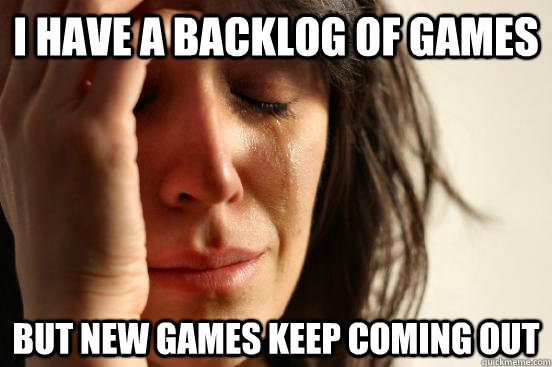
The Bittersweet Backlog
I have a lot of video games. Well, that's an understatement. Honestly I probably own more video games than I could even finish before I die. And yet knowing this, I still collect new games on a weekly basis. More and more virtual voyages added to the unceasing pile. With decades behind me of collecting, one could write it off as simply an old habit. It might be that, but in a positive light one could say this is continuous library building for posterity. Whether or not it's a good thing, the fact remains I own multitudes of video games I have not played yet. They sit neatly organized and alphabetically congealed into segregated areas based on their respective platform. Waiting patiently for their time to shine. The truth is some of them will never get that chance.
It's not that I don't play, oh I play video games as much as I can. "Can" being the operative word there based on playing in my free time. My "free time" being that which I am not spending on my day job, adult responsibilities/chores, family obligations, relationship quality time, additional hobbies and other such necessities. A mature responsible social adult cannot play video games with the same frequency they did as a carefree teen. These days I average twelve to fourteen hours a week because of this reality. I still have to sacrifice plenty of sleep just to pull off that amount.
Due to this situation I am a time traveling gamer. As in, I play games from all eras of gaming. This is born from having a backlog spanning decades. There are still games I haven't played from the 8-bit era that I fully intend to play some day. Despite their technological obsolescence. All the same, I also play brand new modern releases. But what I do not do, is disallow entire eras of gaming just because the next era has begun. There are some people who do this. "The PS4 came out? The PS3 is now dead to me. And don't even talk about the PS2 or PS1, that's just stone age crap." To me this sort of thought process is needlessly dismissive, and illogical. But from a purely technophile point of view, I guess I can understand their side of the argument. I just don't share it.
An example of this? Lately I've been playing King's Field (Japan), a game released in 1994. It is 20 years old currently, but I've only just now gotten around to playing it. One might wonder why I'd bother playing From Software's first release, when I've got a PS3 and their recent Dark Souls sitting in the same room (which I have not played yet). I guess part of my reason would be due to scholarly inquisitiveness. Historically speaking King's Field (Japan) is a significant release. So to play an old game is to go back in time to a degree. A larger degree though, is I'm able to disregard the graphical merit of a game, and rather enjoy its core gameplay as a separate entity. This may have to do with growing up from Atari 2600 graphics. I came from a time when gameplay sold a game as much (or more than) graphics did. Having the ability to see beyond graphics is a double edged sword of course. It means I can't disregard huge swaths of my backlog simply because of their archaic pixels.
Currently my backlog spans from the 1980's to 2014. That's over thirty years of collecting. So how does one begin to dig through a backlog that spans so many years? Trying to prioritize what to play, and realizing one doesn't have time to play it all, can lead to backlog anxiety. Feelings of shame, remorse, and loathing might manifest as a result. I've been there! I understand why folks come up with complex methods of dealing with this. Some sort of regimen, or algorithm, designed to prioritize the top "must plays" or "most expensive rarities" of their respective backlog. I am guilty of concocting such stratagem shenanigans myself in the past. Let me tell you, that's a young man's game. Age has brought me the realization that backlog anxiety is just silly and ultimately toxic. The answer? Acceptance is the key. It's not the same thing as apathy either.
Do I have too many video games? Yes, and I accept that. Do I need to stop buying them until I finish what I already have? That would be financially logical, but psychologically unsatisfying, so no, I won't do that. My fiance and I created a gaming budget for that instead. Will I ever finish every video game I have? Hell no. I will be dead before that can even happen. I accept that. Is there a truly efficient way to choose what to play from one's backlog? Maybe. Do I really care? Not anymore. I accept that. Instead I play what my ardent gamer heart yearns for, regardless of genre, release date, or game time length. Hence I'm playing a Japanese oddity from 1994 right now. Yes I could handle my backlog in a more efficient and hierarchical manner, I know this. But I choose not to. I accept that.
In reality my backlog is a monster. It's a monster that I cannot slay, and yet I feed it more every week. Maybe because I am in awe of its size and like to see it grow. Or maybe my backlog is a well, keeping me hydrated in my unquenchable thirst for new gaming experiences. And therein lies the two sides of the backlog coin. Bitter monster, sweet well. This is true, and I accept it. But I no longer accept my backlog as a source of anxiety. The librarian does not rue the library, nor the curator fear the exhibits. Rather they revel in their potential. And that is the beauty of a big backlog; pure potential. That's why a pile of up-to-date-modern-only games can't match my backlog. My crazy time spanning backlog is a monstrous well of potential. And from it I can always sip a little joy as life permits. So I throw a few coins in it every week, making the wish that it never runs dry.
Wednesday, September 10, 2014
Co-op Couples
Every relationship needs entertainment to combat the boredom lulls. Couples can only frolic in romance and coitus for so long. Often this ends in copious amounts of watching television or window shopping. Initially in my own relationship, my significant other was interested in hiking and playing with our new dog. Fine endeavors indeed, but I wanted to slay dragons and shoot aliens too. So one night as she sat next to me in front of the HDTV, I asked if she wanted to play a video game with me. Her reply was, "I don't play video games, but I'll watch you play them."
This was not an acceptable answer. I was determined to find a video game my lover would enjoy. And so I began showing her quite the variety. Kirby's Epic Yarn made her want to vomit. Bucky O'Hare arcade version? Not a fan. Donkey Kong Country Returns wasn't much fun. After about a dozen random tries like this, I was nearly ready to give up. I just couldn't find the gateway game. So for our last go, I took a wild shot in the dark. That night's final game was ObsCure: The Aftermath; a very difficult, gory, and brutal co-op survival horror game. I figured she'd hate it. I was wrong. She loved it. I had found her gateway game.
After we spent a few evenings finishing ObsCure: The Aftermath, she was ready for more. So over the next few weeks, we took on Resident Evil: The Umbrella Chronicles, Baldur's Gate: Dark Alliance, and Trauma Center: New Blood. We completed them all cooperatively, and she enjoyed every minute. Turns out I had simply underestimated her tastes. She didn't hate video games, she just hated cutesy fluffy ones. She couldn't get enough of the dark and serious stuff though. By sheer determination and experimentation, I had found a golden compromise. I was getting more gaming time, and she was getting new experiences in entertainment. And something even greater was happening beneath the surface. Our relationship was becoming stronger due to the power of cooperative gaming.
This beneficial aspect wasn't something I had consciously realized immediately. But over time, I had noticed that when we were faced with a mutual real life conundrum, our problem solving skills seemed to occur more smoothly then before. I couldn't help but wonder if all those virtual hours spent cooperatively solving puzzles and killing monsters had accomplished more than just entertainment. It seemed that our simultaneous electronic victories somehow translated into real world relational stat bonuses. If nothing else, instinctively we learned to know when to back off from an issue and let the other handle it. I have no doubt that cooperative gaming has helped develop that particular sixth sense more strongly for us.
I am not saying that two people in a relationship playing video games together need nothing else to help strengthen their bonds. Obviously if a marriage is going sour, beating Bubble Bobble together won't replace a counselor's help. I'm only saying that working together to beat a game, mutually overcoming its obstacles together via teamwork, that sort of entertainment has tangible merit. I refuse to believe sitting around watching reality television has the same sort of teamwork building skills as co-op gaming does. And I encourage gamers to get their non-gaming partners into playing games with them because of that. Taking down a huge beast cooperatively in Monster Hunter has got to do more for your relationship than window shopping for new winter coats.
You might be surprised at how many things there are to cooperate on in a video game. For example, in Baldur's Gate: Dark Alliance, there was an entire economy to mutually endure. Firstly you had the finite resource of gold pieces to distribute evenly. Secondly you had random loot drops to dole out fairly. That dropped flame sword might never appear again, so only one of you gets to have it. Who? Which items are worth buying from the shopkeeper, and who gets to keep them? If the path ahead diverges, which hallway do you two take? Who makes that decision? What's the proper strategy to use to kill that boss? And who gets the killing blow? There were so many factors to puzzle over, only to be solved together for the greater victory of cooperation. Surely after doing all of this, divvying up the mundane bills and chores of real life becomes more intuitive.
It stands to reason then, that this same sort of relationship building cooperative gaming magic applies beyond the amorous sphere as well. I could certainly believe beating games together with a close friend would have tangible offsets. If nothing else, you'd learn a little more about each others' personal strengths and weaknesses. (Seriously, if you want to know someone's true personality, play Dokapon Kingdom with them.) So if your partner doesn't play video games, but you'd like them too, just keep trying. There's a genre out there for everybody, and chances are it has some co-op titles available within. Whether you choose to play couch co-op games with your significant other, your friends, or even your children, there are positive results for all involved.
Co-op gaming sites for finding stuff to play:
http://www.co-optimus.com/
http://www.gweep.net/~rocko/coop/
http://en.wikipedia.org/wiki/List_of_cooperative_video_games
http://www.mobygames.com/attribute/sheet/attributeId,619/
Monday, September 8, 2014
Don't Scratch On The Story
Here's a story about the importance of stories.
Flashback to the summer of 2007, I had recently suffered the breakdown of a romantic engagement. It turned out that my then-fiance was cheating on me, so I had to put an end to our long relationship. Some guys would have wallowed in alcohol to drown their sorrows, but I chose to bury mine under a mountain of pixels instead. The pixels in turn were coming from an unusual genre, one I had only just begun to explore.
The genre was "billiards simulations", pool games. I had always enjoyed playing pool in real life, even though I wasn't particularly skilled at it. Thus I felt compelled to give pool games a try. They were after all cheaper, more convenient, and less embarrassing than playing badly at an actual pool hall. To my surprise, I had discovered the original PlayStation had more than a few of these titles (about 25 if you count international releases). That was good because I was financially challenged at that time. The only physical console in my living room back then, was actually an original PlayStation. So for a while it was just myself, an old couch, a small CRT TV, and that beat up old PlayStation. I may not have had love or money, but I had plenty of belated billiards.
In the midst of my broken heart depression, I started scouring pool sims from local discount stores. This was an inexpensive affair, because would you believe the market for vintage billiards games depreciates quickly? Every day I would go to work only to spend my lunch hour finding a new pool game. Then I'd come home and bury my head in angles and trick shots all night. Yes we do strange things when we have broken hearts. All the same it helped keep my head from thinking about someone else's cue stick knocking balls into a side pocket that used to be mine.
Eventually this fascination with pool sims started to wind down. But just as I was about to hang up my virtual rack, I came across one game that spoke to my heart instead of my escapism. This came as quite a surprise. I'd say if you asked me where I was going to find a story in a video game that would resonate with my then-sadness, the last place I would have guessed would be from a pool simulation. Nonetheless, that's exactly what happened when I played Backstreet Billiards.
Backstreet Billiards was published in the USA in 1998 by Ascii Entertainment. As a pool simulation, it had been left in the dust by far more recent evolutions of the genre on newer more powerful consoles. Its physics model was obsolete and its graphics had aged less than gracefully. After all, this was 2007, Backstreet Billiards was nearly a decade old by then. Who cared about playing pool with a controller when you could push a Wii Remote as a virtual cue? All the same, one aspect of a video game has the ability to never age, to never become obsolete, for it is immune to hardware obsolescence. A game's story.
Allow me to give a quick run down of Backstreet Billiards' story. You play as a young man who is seeking his recently deceased famous pool ace father's legendary cue stick. It has been stolen by an unknown thief, thus you begin to search your way through the pool playing underground in hope of reclaiming your lost heritage. When you beat key characters at pool, they reveal to you more clues and leads as to who the unknown thief actually is. Now, Backstreet Billiards' story was not earth shattering, granted. It did not mire itself in melodrama, pathos, or any grandiose ambition. But it did manage to entice emotion from my recently wounded soul regardless. The key emotion was empathy. Empathy is why I still remember Backstreet Billiards, while I scarcely remember any of the other pool games I played during that time.
The young man seeking the pool cue was only doing so on the surface. Superficially speaking, he wanted it back for heritage purposes, sure. But on a deeper level, this man unknowingly was trying to get a piece of his father back. If he could just hold that stolen pool cue again, he'd be that much closer to the dad he'd just lost. And that aspect of the story resonated with me. I too had just lost something to a death recently. The death of a relationship, the loss of trust, and the theft of my own sense of self worth. Maybe all those nights playing virtual pool matches I was simply trying to win at something again. Was I trying to attain small senses of victory to dissuade the pangs of being a loser at love? It's a feasible possibility.
Backstreet Billiards, by its simple merit of having a decent story, made something as banal as a pool simulation become so much more. When I realized the power of this, the possibilities seemed limitless for games' emotional potential. You could make a pong game seem meaningful by simply inserting a well written story into it. Indeed with proper cut scenes, you could forge a murder mystery out of Tetris. Ten years from now, you'd still remember how Sergeant Smash lost his leg in the best Minesweeper clone you ever played. All because of the power of a good story.
Story is what gives meaning to all those pixels on the screen. And a good story does even more than that, it infuses humanity into what amounts to cold digital technology without it. There likely will come a day when I can play billiards in virtual reality, with graphics indistinguishable from real life. Yet even then, I would still swear that Backstreet Billiards is the best pool game ever made. All because Backstreet Billiards spoke to my heart, instead of just my eyes. Truly games that base their sole merit on graphics hang their worth upon an expiration date.
I believe modern video games have astounding graphics, fantastic audio, a plethora of control options, and a healthy variety of genres to choose from. But I do not believe video games as a holistic medium have enough heart in them. There are a few titles that stand out (CiNG's stuff for sure), but exceptions don't make the common rule. I truly hope in the future more game developers come to realize just how important a proper plot truly is. Well designed stories, characters, and dialogue are what make society at large respect books and film as a critical medium. As a species humans love being told tales. It's probably genetic. It stands to reason then, that solid well written plots can excel video games to the culturally exalted status other mediums enjoy.
We have amazing programmers, artists, musicians, and gameplay designers. What we don't have enough of though, is amazing game writers. Game studios should strive to always remember the importance of story. To never forget to infuse some legitimate humanity into the mix of bits and pixels. If you manage to make your player feel raw emotion, instead of just mechanical reaction, you stand a chance of enticing empathy. And empathy inevitably makes a person feel closer to something. If that something is a video game, than that player shall cherish and remember said video game possibly the rest of their life. And when they do, they will remember that game as a life experience unto itself, rather than just an entertaining distraction from other life experiences around them.
Technology always has an expiration date, but a well written story never expires. For now, video game escapism and actual player empathy hit like an 8-ball and a lucky call. There's just far too many missed shots. Developers, it's time to step up your game as a whole. A good game designer is not necessarily a good game writer. So it's time to consistently hire actual writers to write the plots of video games. Or are we all content to let books and films keep hustling games at the table? A broken heart can fall in love anew, even with a video game. Let the games love us back more often then, and maybe our wallets won't cheat on them as much.
Flashback to the summer of 2007, I had recently suffered the breakdown of a romantic engagement. It turned out that my then-fiance was cheating on me, so I had to put an end to our long relationship. Some guys would have wallowed in alcohol to drown their sorrows, but I chose to bury mine under a mountain of pixels instead. The pixels in turn were coming from an unusual genre, one I had only just begun to explore.
The genre was "billiards simulations", pool games. I had always enjoyed playing pool in real life, even though I wasn't particularly skilled at it. Thus I felt compelled to give pool games a try. They were after all cheaper, more convenient, and less embarrassing than playing badly at an actual pool hall. To my surprise, I had discovered the original PlayStation had more than a few of these titles (about 25 if you count international releases). That was good because I was financially challenged at that time. The only physical console in my living room back then, was actually an original PlayStation. So for a while it was just myself, an old couch, a small CRT TV, and that beat up old PlayStation. I may not have had love or money, but I had plenty of belated billiards.
In the midst of my broken heart depression, I started scouring pool sims from local discount stores. This was an inexpensive affair, because would you believe the market for vintage billiards games depreciates quickly? Every day I would go to work only to spend my lunch hour finding a new pool game. Then I'd come home and bury my head in angles and trick shots all night. Yes we do strange things when we have broken hearts. All the same it helped keep my head from thinking about someone else's cue stick knocking balls into a side pocket that used to be mine.
Eventually this fascination with pool sims started to wind down. But just as I was about to hang up my virtual rack, I came across one game that spoke to my heart instead of my escapism. This came as quite a surprise. I'd say if you asked me where I was going to find a story in a video game that would resonate with my then-sadness, the last place I would have guessed would be from a pool simulation. Nonetheless, that's exactly what happened when I played Backstreet Billiards.
Backstreet Billiards was published in the USA in 1998 by Ascii Entertainment. As a pool simulation, it had been left in the dust by far more recent evolutions of the genre on newer more powerful consoles. Its physics model was obsolete and its graphics had aged less than gracefully. After all, this was 2007, Backstreet Billiards was nearly a decade old by then. Who cared about playing pool with a controller when you could push a Wii Remote as a virtual cue? All the same, one aspect of a video game has the ability to never age, to never become obsolete, for it is immune to hardware obsolescence. A game's story.
Allow me to give a quick run down of Backstreet Billiards' story. You play as a young man who is seeking his recently deceased famous pool ace father's legendary cue stick. It has been stolen by an unknown thief, thus you begin to search your way through the pool playing underground in hope of reclaiming your lost heritage. When you beat key characters at pool, they reveal to you more clues and leads as to who the unknown thief actually is. Now, Backstreet Billiards' story was not earth shattering, granted. It did not mire itself in melodrama, pathos, or any grandiose ambition. But it did manage to entice emotion from my recently wounded soul regardless. The key emotion was empathy. Empathy is why I still remember Backstreet Billiards, while I scarcely remember any of the other pool games I played during that time.
The young man seeking the pool cue was only doing so on the surface. Superficially speaking, he wanted it back for heritage purposes, sure. But on a deeper level, this man unknowingly was trying to get a piece of his father back. If he could just hold that stolen pool cue again, he'd be that much closer to the dad he'd just lost. And that aspect of the story resonated with me. I too had just lost something to a death recently. The death of a relationship, the loss of trust, and the theft of my own sense of self worth. Maybe all those nights playing virtual pool matches I was simply trying to win at something again. Was I trying to attain small senses of victory to dissuade the pangs of being a loser at love? It's a feasible possibility.
Story is what gives meaning to all those pixels on the screen. And a good story does even more than that, it infuses humanity into what amounts to cold digital technology without it. There likely will come a day when I can play billiards in virtual reality, with graphics indistinguishable from real life. Yet even then, I would still swear that Backstreet Billiards is the best pool game ever made. All because Backstreet Billiards spoke to my heart, instead of just my eyes. Truly games that base their sole merit on graphics hang their worth upon an expiration date.
I believe modern video games have astounding graphics, fantastic audio, a plethora of control options, and a healthy variety of genres to choose from. But I do not believe video games as a holistic medium have enough heart in them. There are a few titles that stand out (CiNG's stuff for sure), but exceptions don't make the common rule. I truly hope in the future more game developers come to realize just how important a proper plot truly is. Well designed stories, characters, and dialogue are what make society at large respect books and film as a critical medium. As a species humans love being told tales. It's probably genetic. It stands to reason then, that solid well written plots can excel video games to the culturally exalted status other mediums enjoy.
We have amazing programmers, artists, musicians, and gameplay designers. What we don't have enough of though, is amazing game writers. Game studios should strive to always remember the importance of story. To never forget to infuse some legitimate humanity into the mix of bits and pixels. If you manage to make your player feel raw emotion, instead of just mechanical reaction, you stand a chance of enticing empathy. And empathy inevitably makes a person feel closer to something. If that something is a video game, than that player shall cherish and remember said video game possibly the rest of their life. And when they do, they will remember that game as a life experience unto itself, rather than just an entertaining distraction from other life experiences around them.
Technology always has an expiration date, but a well written story never expires. For now, video game escapism and actual player empathy hit like an 8-ball and a lucky call. There's just far too many missed shots. Developers, it's time to step up your game as a whole. A good game designer is not necessarily a good game writer. So it's time to consistently hire actual writers to write the plots of video games. Or are we all content to let books and films keep hustling games at the table? A broken heart can fall in love anew, even with a video game. Let the games love us back more often then, and maybe our wallets won't cheat on them as much.
Subscribe to:
Posts (Atom)